Of the effects of the Crusades I shall only mention those which are directly illustrated by the story of Chartres. They rolled back the tide of Mahometan conquest from Constantinople; they brought together East and West, and led to the awakening of the human intellect which was to put an end to the dark ages; they opened up new markets and stimulated trade to a wonderful degree--these great results they had, but they only affected Chartres indirectly. More directly we see the effect of them in the relations between the powers that were. By weakening the resources and influence of the barons they strengthened the authority of the Kings acting in alliance with the citizens. And this alliance broke up the feudal system, gradually abolished serfdom, and substituted the authority of a common law for the unstable will of chiefs, whose arbitrament was private war. Last and not least permanent of the effects of the Crusades was the influence exercised by the East upon art. The Porche Royal of the Cathedral, and the stained glass windows which are the glory of Chartres, would not have been as they are had Peter the Hermit never led his hundred thousand pilgrims to destruction, or if Bohémond, Prince of Antioch, had not taken the Cross in the sanctuary of Notre-Dame.
The foundation of the Abbey Josaphat-Lès-Chartres, which, like so many other religious foundations rich in lands, in relics and in books, was destroyed in 1789, affords another example of the indirect influence of the Crusades upon the institutions of Chartres. This abbey[48] was situated about two kilometres from Chartres, under the Hill of Lèves, on a site which in its topographical relations resembled that Valley of Jehosaphat to which its founder, Bishop Geoffrey, the successor of S. Ives, had vowed to go, but came into the bishopric instead. Even so S. Bernard recalled the town of Tyre to the memory of all Christians in the name of Tyron, which he gave to the monastery which he founded in Le Perche on lands given to him by S. Ives.

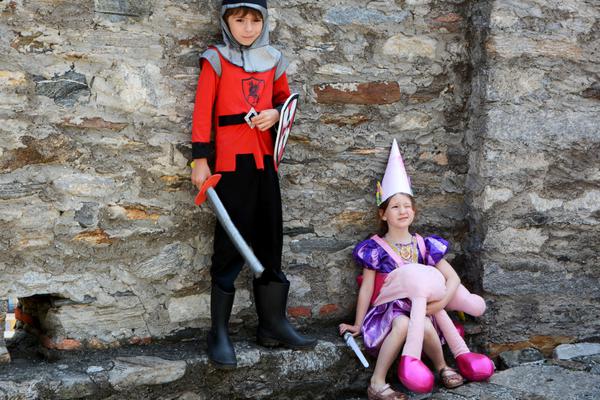
It was to the Abbey of Josaphat that, up to the days of the Revolution, the musicians and choristers of Notre-Dame made yearly, in the vintage season, a strange kind of equestrian promenade, known as the _Chevauchée_. This probably represented the survival of some feudal obligation. The chevaucheurs in a dignified Latin speech obtained leave from the Chapter to perform their functions, and then, before leaving the Cathedral, they used to sing the office of the day. But once _en route_ the cavalcade became as noisy and riotous a scene of carnival as the Feast of Fools. Riding on horses and donkeys, clad in outrageous garments of all colours, armed with swords, wearing absurd hats, and making a deplorable noise with all kinds of instruments, the cacophonous cavalcade made its way through the laughing, boisterous throng, to _déjeûner_ at the Abbey of Josaphat. The Feast of Fools, to which I have referred, like this amazing excursion, was celebrated in the odour of scandal down to the end of the eighteenth century. It was a feast widely popular in France, but much more licentious than religious. It was held at Chartres on the 1st of January. An admirable picture of the Feast of Fools as observed at Notre-Dame-de-Paris five days later is drawn by Victor Hugo in the first chapters of his novel of that name.